

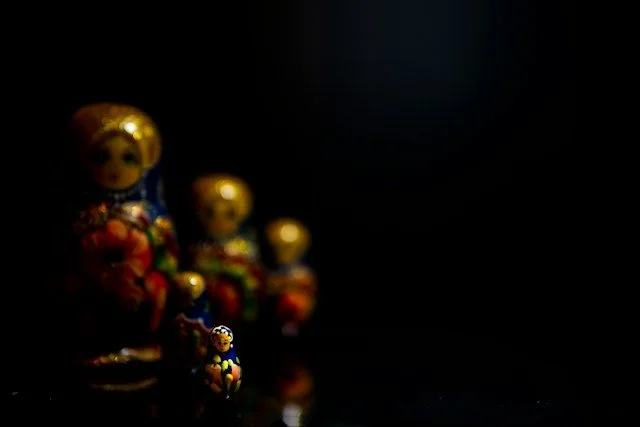
Recently, in a yoga class, one of the ladies described her situation as a little babushka doll in a set, and I knew exactly what she meant.
She is sandwiched between older relatives who are beginning to need more from her, younger children who still need her in different ways, a full-time job, a partner, friends and all the everyday responsibilities that seem to accumulate as we get older, and somewhere in the middle of all of this, she has started to lose sight of who she actually is.
The thing is, from the outside, she has what most people would probably describe as a good life. She has a good job and people she loves; she is intelligent, funny and articulate.
There is nothing about her life that would necessarily make somebody think that she should be struggling with her sense of identity or wondering what happened to the person she used to be.
So why does she, and why do so many other women reach their 40s and 50s and find themselves feeling lost, stuck or strangely disconnected from their own lives?
I think this is one of the things about midlife that we don't always talk about very honestly.
We often hear about the more obvious changes that can happen during this stage of life, whether that is children becoming more independent, ageing parents, changes in our careers, relationships, our physical health or simply the realisation that we are getting older and perhaps have more of our lives behind us than we have in front of us.
All of these things can make us stop and think, but another change can be much harder to put your finger on: the growing awareness that you have spent a long time being needed by other people and have gradually become less connected to yourself.
You can be grateful for your life and still want something to change

One of the things I hear from women is that they feel guilty for feeling the way they do because, when they look at their lives objectively, they know they have a lot to be grateful for.
They may have a family they love, a home, a career, good friends and many things that they would never want to lose, so when they admit that they feel restless, stuck or dissatisfied, they can almost feel as though they have no right to feel that way.
But gratitude and wanting something to change are not mutually exclusive.
Something we all need to remember is that you can be very grateful for your life and still feel that something is missing.
You can love your children and still want more time for yourself; you can care deeply about your parents and still sometimes wish that you weren't the person who had to organise everything, and you can have a good relationship or a successful career and still wonder whether this is really how you want the next ten or twenty years of your life to look.
I think this is particularly important because women can be very hard on themselves when they reach this point. They look at what they have and tell themselves that they should be happy, when perhaps the more useful question is not “Why am I not happy with all of this?” but “What is it that I need now that I didn't need before?”
Because as you have aged and transitioned through different life stages, you have changed; it would be strange if you hadn't.
When everyone needs something from you

When I was told of the babushka analogy, it made perfect sense because I think it describes the experience of a lot of women remarkably well.
You are in the middle, sandwiched in between people who need you. You could also be trying to keep your career going, maintain friendships, look after your relationship, run a home and somehow find enough energy at the end of the day to remember that you are a person with needs too.
And the thing most women understand is that these commitments aren’t things they resent; they are facts of life.
You want to be there for the people you love; you want to help your parents when they need you; support your children, be a good partner and friend, and you want to do your job well.
These are not burdens that somebody has necessarily forced upon you; they are often things you have chosen because you care about the people involved, and they can bring you joy and contentment. You find the time and the energy for them, so why, when it comes to you, does everything suddenly become more complicated?
Why is it so much easier to find time to help somebody else than it is to find time to do something simply because you want to? Why can spending an afternoon doing something for yourself bring up guilt when you wouldn't think twice about spending that same afternoon helping someone you care about?
And perhaps the bigger question is, when did you start believing that your own needs were less important?
Why do women feel guilty for wanting time for themselves?
One of the things I hear most from women during coaching sessions is that they feel guilty, and I fully understand that feeling, as it is something I have had to deal with as well.
They question why they feel guilty doing something for themselves or wanting time out, and I think part of the answer is that many women become very comfortable in the role of being the person who gives, organises, remembers, supports and takes care of things, while their own needs become something they can deal with later.
Of course, the problem with later is that there is always something else that seems more urgent. Somebody needs picking up, your parent has an appointment, work needs finishing, your partner needs your attention, the house needs sorting out, somebody has a problem they need to talk through, and before you know it the day has disappeared, and the thing you wanted to do for yourself has been pushed to another day.
Then another day becomes next week, next week becomes next month, and eventually you can find yourself wondering when you last did something simply because you wanted to.
It is very easy to tell yourself that you will have more time later, particularly when there are genuine responsibilities that need your attention, but the reality is that there will probably always be somebody who needs something from you.
If you keep waiting until everyone else is sorted, you could be waiting for a very long time.
What happens if you keep putting yourself last?
This is the part I think we need to be honest about, because it is very easy to understand why women put themselves last and then simply accept that this is how life has to be.

Perhaps nothing dramatic happens if you continue doing it. You simply carry on with your life, doing what needs to be done and being there for the people who matter to you, but gradually you become more tired, more disconnected from yourself and less sure about what you actually want.
You may find that you are irritable or resentful in ways that you don't really understand, or that you feel as though you are constantly doing things for everybody else but aren't getting much enjoyment from your own life.
You may even reach a point where somebody asks you what you would like to do, where you would like to go or what you are interested in, and you genuinely don't know how to answer.
That can be quite frightening.
Not because there is something wrong with you, but because you have spent so long being defined by what you do for other people that you have lost touch with the parts of yourself that exist independently of those roles.
And if you don't do anything about it, where does that leave you?
Perhaps another year passes, and then another, while you continue waiting for the right time to think about yourself.
Finding yourself again in midlife
I don't think finding yourself again necessarily means completely reinventing your life, and I am wary of some of the messages around midlife that suggest you need to discover a new purpose, start an entirely new career or become a completely different version of yourself. Sometimes what you need isn't a new life at all; it is more space within the life you already have to remember who you are and what matters to you.
That might mean asking yourself what you actually enjoy now, rather than what you enjoyed ten or twenty years ago, because the person you are today may have very different interests and priorities.
It might mean thinking about something you have always wanted to try but continually put off, or recognising that there are parts of yourself that have been neglected because there simply hasn't been enough time or energy left for them.
It might even be something very simple. Perhaps you want to start exercising again, take up painting, read more, travel, spend time with friends, learn something new, change direction professionally or simply have an hour every week when nobody needs anything from you.
The point isn't really what you choose to do; the point is that you start asking yourself the question.
What do I want?
And if you have been putting yourself last for years, don't be surprised if you don't immediately know the answer. You may have to get to know yourself again.
You don't have to care less about everyone else

I think this is where the conversation about looking after yourself can sometimes become too simplistic, because most women I speak to don't want to become less caring and they don't want to walk away from the people they love.
They want to continue being mothers, partners, daughters, friends and colleagues, and they want to be there for the people who matter to them; what they are beginning to realise is that they don't want those roles to completely define them.
There is a difference between caring for other people and disappearing into the care of other people.
You can continue to support your family while also making space for yourself, and you can be there for somebody else without automatically assuming that your own needs should come last every single time.
You are one of the people you are responsible for too.
That doesn't mean putting yourself first in every situation, because real life doesn't work like that, but it does mean recognising that your needs matter and that continually ignoring them has consequences.
Perhaps midlife isn't about finding a new you
Maybe the question isn't “How do I reinvent myself?” at all.
Perhaps it is simply “Where did I lose touch with myself, and what would it take to find my way back?”
Because the woman you were before you became responsible for everybody else hasn't necessarily disappeared. She may simply have been pushed further and further down the list until there was very little room left for her.
And perhaps this is what makes midlife such an important stage of life for women, because it gives us an opportunity to stop for a moment and ask whether the way we are living still reflects who we are and what we want.
You don't have to wait until you are completely burnt out or desperately unhappy before you decide that something needs to change.
You can start by noticing the feeling.
You can start by admitting that you want something different.
You can start by allowing yourself to have time that belongs to you without immediately feeling that you need to justify it.
And you can start asking yourself what you want the next chapter of your life to look like, even if you don't have the faintest idea what the answer is yet.
Because there will always be somebody who needs something from you. There will always be another job to do, another problem to solve, another person you could help and another reason why your own needs can wait until tomorrow.
But if everyone else has a place in your life and you don't feel as though there is much room left for you, perhaps it is time to ask yourself a very simple question.
What about me?
If you're feeling stuck in midlife

If you recognise yourself in this and you have reached a point where you know something needs to change but you aren't quite sure what that change should look like, this is exactly the kind of thing I help women explore through coaching.
You don't need to arrive with a clear goal or know exactly what you want to do next, because sometimes the starting point is simply having the opportunity to talk honestly about where you are, what has changed, what no longer feels right and what you would like your life to look like from here.
If you would like to explore that, you can book a free discovery call with me. It is an informal conversation where we can talk about where you are now and what you would like to change, and you can decide whether coaching feels like the right next step for you.
There is no obligation to work with me; sometimes having an honest conversation with someone outside your usual circle is enough to help you see your situation a little differently.
